Product Description
Uttarakhand_Our_Culture_Our_Heritage
Aipan
Cow 🐄 Mother's life is the light of the earth.
Save Cow 🐄 Save Culture, Save Nature
Aipan Art is a vibrant platform showcasing the traditional Indian folk art of Aipan and galvanizing a movement to preserve our cultural heritage. We create exquisite Aipan designs, empower local artisans, promote cultural exchange, and inspire a new generation to appreciate the beauty and significance of this ancient art form.
Artwork
🏔 Traditional Method of Uttarakhand
This special Aipan is prepared using the traditional method of Uttarakhand:
✔ On cotton cloth
✔ A paste of cow dung and cow urine
✔ A base of ochre soil
✔ Aipan with ground rice paste (viswar)
🌿 Spiritual Significance of the Materials Used
🐄 Importance of Cow Urine
Cow urine is considered extremely sacred in the scriptures. It is believed to help remove negative energy and Vastu defects and remove obstacles to auspicious tasks.
🐄 Importance of Cow Dung
According to Vastu Shastra, cow dung is extremely sacred and effective. It removes negative energies from the home and transmits positive energy.
🧱 Importance of Ochre Soil
Ochre soil has special significance for religious and ritualistic purposes. It is used in religious structures and paintings.
🌾 Importance of Rice (Akshat)
Akshat means unbroken, a symbol of completeness and concentration.
The use of rice in worship is considered extremely auspicious.
It symbolizes power, prosperity, and peace.
The worship of any deity is not considered complete without rice.
Rice holds special significance for receiving the blessings of Goddess Lakshmi and Goddess Annapurna.
📏 Size Details
Cotton Cloth Size: 20" × 20"
Aipan Size: 18" × 18"
Materials Used:
Cow urine
Dung of a local cow
Ochre clay
White color – from ground rice flour
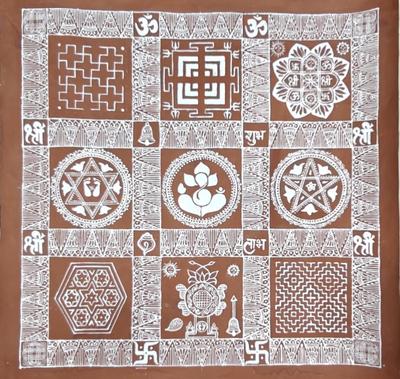
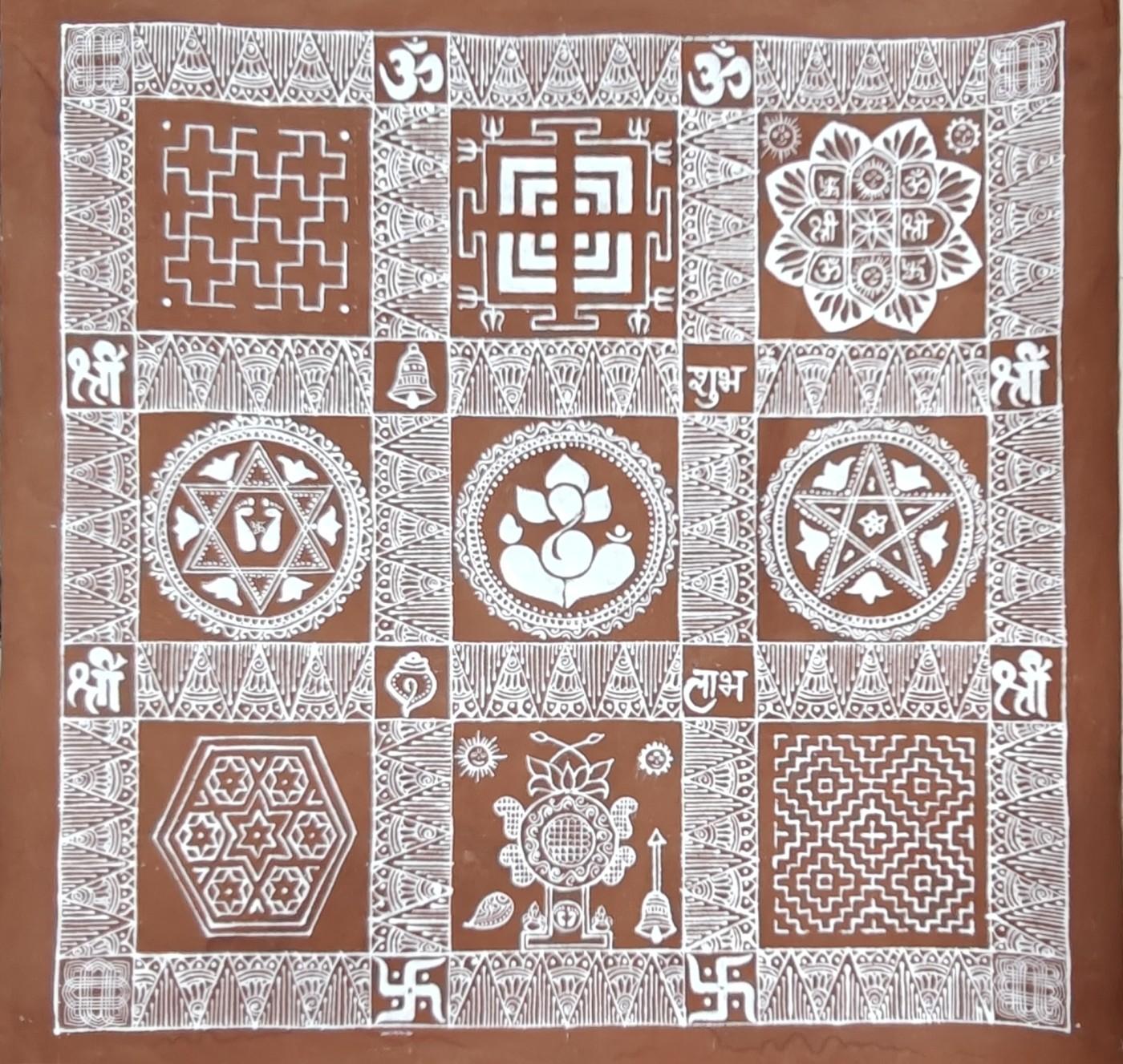
An attempt has been made to integrate various forms of Aipan art into a single thread, as follows:
1- Navdurga Peetha
Aipan is used during Navratri Devi Puja in Uttarakhand, India. Women create this platform at the place of worship for the Kalash installation on the first day of Navratri. The main theme here is nine dots, representing the nine Durgas. We create a square by encircling each of these dots with nine parallel lines, and then form nine swastikas, also known as Nav Swastikas, from these dots. Then, decorate this square using horizontal and diagonal lines surrounded by eight lotus petals.
2- Shiv Peetha
Aipan (or Shiv Archana Peetha) is a sacred, traditional Kumaoni folk art of Uttarakhand, created specifically for the worship of Lord Shiva during the months of Sawan and Magh. It consists of a 6, 8, 10, or 12-dot hexagon-based, symmetrical geometric pattern created to place the Parthiva Linga (earthen Shiva Lingam) on a floor or cloth smeared with red and white ochre, providing a protective, spiritual, and ceremonial effect.
3- Namkaran Peetha
(Also known as Namkaran Chowki or Surya Darshan Chowki) is a special form of Aipan, a traditional ritual folk art from the Kumaon region of Uttarakhand. It is created to mark the naming ceremony of a newborn baby, which usually takes place on the eleventh day after birth.
The detailed aspects of Namkaran Peetha are as follows:
Purpose and Significance
Surya Darshan: In this ceremony, the baby is brought out to see the sun (Surya Darshan) for the first time. Aipan is created in the courtyard where this ritual takes place.
Auspicious Occasion: It is considered a sacred art that seeks blessings for the newborn's health, longevity, and prosperity.
Symbolism: The shapes are believed to ward off evil and protect the child.
Swastika: The central symbol symbolizing auspiciousness.
Sun and Moon: Represent the energy and light of life.
Bell and Conch: Represent purity and divine sound.
Lotus/Ashtadal Kamal: Often used to represent purity and growth.
4- Lakshmi Peetha
A sacred, ritualistic Aipan art from Uttarakhand, featuring symbolic footprints of Goddess Lakshmi, traditionally created during Diwali and special rituals to invite prosperity. Created by Kumaoni women using white rice paste (Biswar) on a red-ocher (geru) background, it often features intricate, symmetrical, diamond-shaped patterns.
Key details of Lakshmi Peetha Aipan art:
Significance: It symbolizes the arrival of Goddess Lakshmi (Lakshmi Pada) into the home, intended to bring good fortune, wealth, and ward off evil forces.
Main motif: The central design features Lakshmi's footprints, often surrounded by intricate geometric patterns, floral motifs, or representations of diyas (lamps).
Place: It is typically created at the entrance, in the courtyard, or at a place of worship.
Occasion: Primarily created during Diwali, Lakshmi Puja, and other auspicious household celebrations.
This traditional art form, often referred to as "Lakshmi Chowki" or "Lakshmi Peetha," reflects the blend of deep spiritual faith and cultural heritage in Uttarakhand.
5- Ganesh Peetha
A traditional, sacred folk art of Uttarakhand, depicting Lord Ganesha with white rice paste on a dark red ochre (geru) background. Representing wisdom and prosperity, it is typically created on floors or walls during festivals, weddings, and in prayer rooms to invoke divine blessings.
Key details of Ganesh Peetha Aipan art:
Design and motif: The design typically features Ganesha in the center, surrounded by intricate geometric patterns, such as conch shells, lotus flowers (padma), and diya motifs, often within a square "chowki" or border.
This art is considered a "peetha," often used as a sacred base for placing idols or performing rituals during puja.
6- Saraswati Peetha
Saraswati Chowki Aipan is a sacred, traditional folk art form from the Kumaon region of Uttarakhand, dedicated to the goddess of knowledge, wisdom, and the arts. It is a ritualistic design, typically hand-painted with white rice flour (biswar) on a base of red ochre (geru), used to create an auspicious space for educational ceremonies.
Key details of Saraswati Peetha Aipan:
Purpose: Created during Vasant Panchami, and especially for a child's 'Aksharambh Sanskar' (initiation into writing) or whenever Goddess Saraswati is worshipped to seek blessings for academic success and creativity.
Core design components:
Central motif: A five-pointed star, representing the goddess and knowledge.
Centerpiece: Often a swastika, a diya (lamp), or a floral pattern in the center. Elements: Complex geometric and floral patterns, lotus designs (the goddess's seat), and conch shells, which symbolize purity and auspiciousness.
7- Janeu Peetha
Janeu Chowki is a distinctive, sacred, and intricate type of Aipan art from the Kumaon region of Uttarakhand, traditionally created on the floor during a boy's sacred thread ceremony (Janeu/Vratabandha). It is a ritual painting created to mark this auspicious occasion and ensure divine blessings.
Key details about the Janeu Peetha Aipan are as follows:
1. Main Design Motif
Sapta-Rishi Pattern: The main part of the Janeu Chowki consists of seven stars, often arranged within a hexagon, symbolizing the "Sapta-Rishis" (seven sages).
Geometric Precision: The design is highly geometric, typically consisting of 15 dots in a row that decrease in number, typically down to 8 on either side, creating a structured, symmetrical form. Surrounding Designs: The central design features intricate floral designs, lines, and dots.
Symbolism: It represents the boy's transition to a new phase in life, invoking wisdom and protection.
3. Significance
Ceremonial Significance: Exclusive to the sacred thread ceremony, it is marked as the "Janeu Chowki" or "Janeu Peetha."
Cultural Tradition: It is a cherished, hereditary art passed down through generations of women in Uttarakhand.
Auspiciousness: It is believed to bring good luck, invoke divine power, and ward off evil.
8- Dhuli Arghya
The Wedding Peetha (or Wedding Chowki) Aipan is a highly distinctive, sacred form of traditional folk art from the Kumaon region of Uttarakhand, created specifically for weddings and auspicious marital rituals. It serves as a sacred place for rituals and is believed to receive divine blessings for a prosperous, long-lasting married life.
Common Designs in Wedding Peetha
Wedding Chowki Design: This is the centerpiece, often featuring intricate geometric designs, swastikas, and lotus designs, creating a sacred platform for the bride and groom.
Dhuli Arghya: A long, straight design used to welcome the groom. It represents the groom as 'Narayan' (God).
Swastika: Represents happiness and spiritual prosperity.
Padprint: Footprints representing the arrival of Goddess Lakshmi (the bride).
Vasudhara: A border design made of continuous straight lines (always in odd numbers, such as 5, 7, 9, or 11).
Uses and Significance
Religious Place: The wedding seat is the special place where the bride and groom sit during wedding rituals.
Cultural Significance: This is a tradition passed down through generations among Kumaoni women, showcasing the fusion of art and spirituality.
Protection: These designs are believed to ward off evil forces and bring good luck.
9- Kanyadaan Chowki or Parigrahna Peetha
The most important of the wedding rituals is the Kanyadaan. Kanyadaan means the gift of a daughter. The father hands over his daughter's hand to the groom. This is a very emotional ceremony for both the parents and the bride. A Bhadra structure is created in the center of the Kanyadaan Chowki. The Bhadra structure is made of 19 points. The meaning of the word Bhadra is evident in its name itself. Bhadra structures are used during rituals like Udyapan, Pratishtha, and Yagna. The 19 points are placed in a row, with 19 points directly above them. The Kanyadan Chowki is constructed by connecting the dots. Its multiplication table and easy platform are created, with the groom's side on one side and the bride's side on the other. It is protected on all sides by Lakshmi's feet. It is erected at the site of the havan (fire sacrifice) during the Kanyadan ceremony. At the time of marriage, the groom is considered Narayan and the bride is considered Lakshmi.